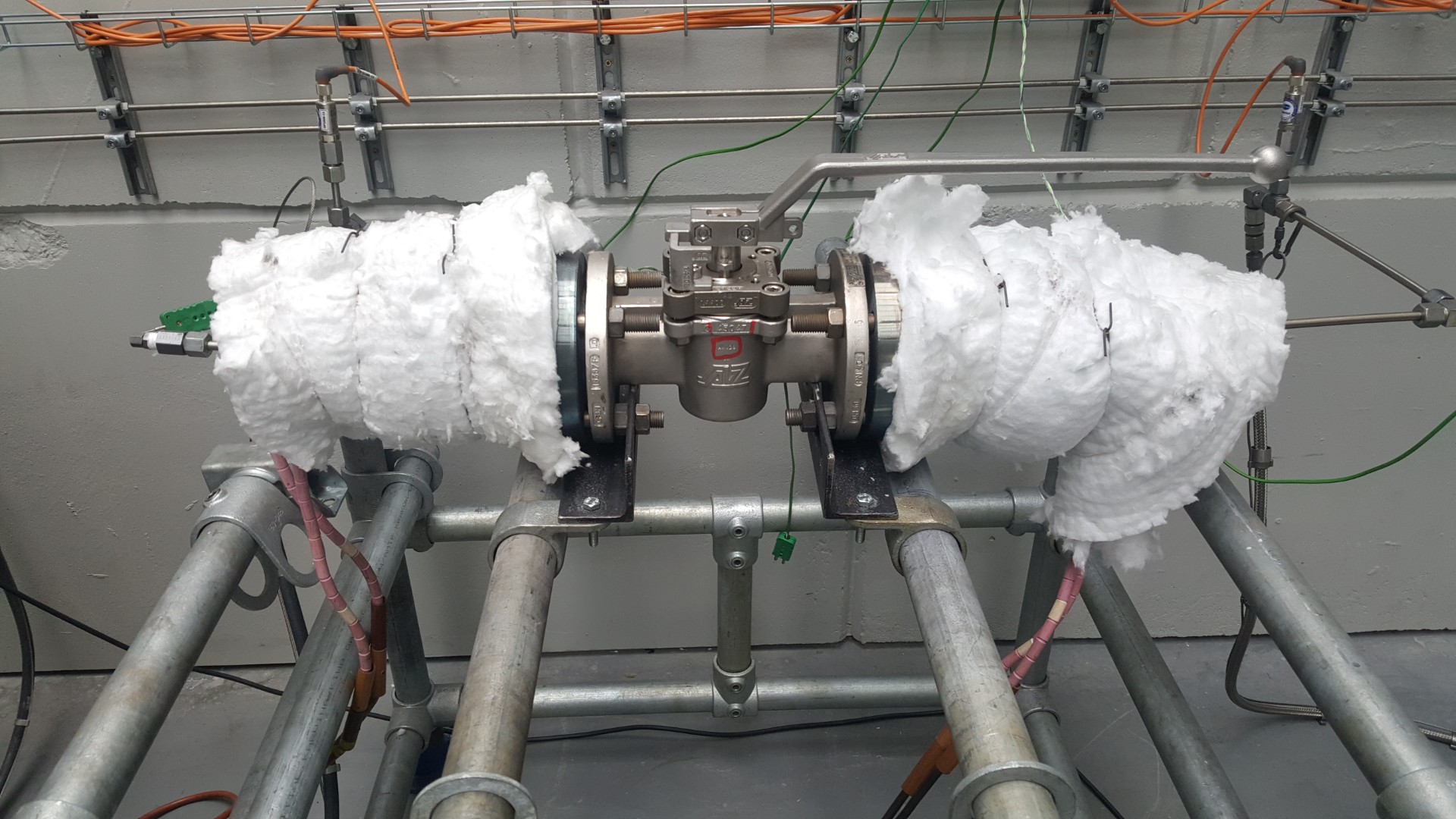
Hoge temperatuur test ITIS

High temperatures place a heavy strain on materials, seals, and structures. In practice, thermal expansion, relaxation, and changing sealing behavior can lead to leaks, operational issues, or premature wear. With a high-temperature test from ITIS, you gain certainty in advance: we assess how your components function at elevated process or design temperatures, fully controlled and in accordance with relevant standards.

Through precise temperature control, continuous monitoring, and objective measurement data, we clearly map out the operational limits of your design or installation. This allows you to prevent downtime, strengthen the reliability of your systems, and possess demonstrable verification for engineering, procurement, and compliance purposes.

Do you want to be certain how your components perform when the heat is really on? Discover what a high-temperature test from ITIS can do for you.

Want a high-temperature test?

Got questions or want to have a high-temperature test performed? Contact us directly, we’re happy to help!

What is a high-temperature test?

A high-temperature test assesses whether components, materials and seals continue to operate reliably at elevated temperatures that are representative for your process. This is done in accordance with client requirements or relevant standards, with clear acceptance criteria and traceable measurement data. With specially developed heating, measuring and control equipment we keep the temperature strictly within limits by means of accurate control and continuous monitoring.

Why is a high-temperature test necessary for you?

  • Elevated temperature affects tolerances, expansion, friction and sealing behaviour.
  • Sealing materials can relax at higher temperatures and after returning to ambient temperature, reducing preload.
  • Without verification you risk internal and/or external leakage, operating issues and accelerated wear.
  • With a targeted test programme we determine the operating limits and explicitly examine the behaviour of seals during heating and after cooling, so unplanned downtime is prevented.

Who is this high-temperature test for?

End users of industrial installations

  • Verify performance at operating temperature before commissioning, after modifications or overhaul, and for prototypes regarding function and reliability.
  • Increase certainty and reliability by having independent verification tests carried out at operating or design temperatures, thus reducing operational risks.

Manufacturers and suppliers

  • Validate design choices, material combinations and sealing concepts.
  • Substantiate type and product approvals with objective measurement data and clear reports.
  • Increase confidence among end users with demonstrable results from high-temperature tests.

Applications
Chemical and petrochemical processes, power plants and steam installations, R&D and qualification trajectories where product performance at elevated temperature must be demonstrated.

Why have ITIS perform a high-temperature test?

  • Execution according to a predefined test programme and chosen heating method, with controlled heating process and stabilisation times.
  • Functional tests: operation (open/closed), stroke/torque or force, followed by measurements of internal and external leakages.
  • Continuous temperature management with measurements at critical positions of the test object, both externally and, where possible, internally.
  • Traceable test results with calibrated instruments and data logging of all measurement data.
  • Unambiguous documentation of test conditions, configurations and acceptance criteria in the report.

Standards during the high-temperature test

Depending on product, application and client requirements, the following can be requested, among others:

  • ISO 15848-1/-2 (fugitive emissions, incl. thermal cycles)
  • API 624 (rising-stem valves, emission test at high temperature)
  • API 641 (quarter-turn valves, emission test at high temperature)
  • API 622 (packing qualification for 624/641)
  • ISO 5208 / API 598 (pressure and tightness testing of valves)
  • Shell MESC SPE 77/300 (client specification for type/design validation)
  • EN 13555:2021 (gasket testing)

Why have ITIS perform a high-temperature test?

ITIS combines in-depth testing expertise with a fully equipped laboratory, experienced test technicians and stable temperature control. We work independently, transparently and reproducibly so you can base decisions on measured data. Our approach aligns with client specifications and international standards, with clear planning, explicit acceptance criteria and a report that can be used directly in engineering, purchasing and compliance.

What will a high-temperature test with us deliver for your company?

  • Objective proof of functionality and tightness at elevated process temperatures.
  • Insight into operating limits and any corrective measures.
  • Faster acceptance by customer or asset owner thanks to transparent, clear reporting.
  • Early detection under operating or design conditions reduces the chance of unplanned shutdowns and lowers failure costs.
  • Compliance with relevant standards and client specifications.

The right report and certification

You receive a detailed test report with test setup, temperature graphs, measurement results and findings, including the translation of acceptance criteria into practical measurement results. Where applicable we perform under ISO 17025 accreditation; such reports are internationally recognised and provide extra legal and contractual value. If desired, the test can be followed via a secure livestream.

Accredited, assurance for you

ITIS is accredited by the Dutch Accreditation Council (RvA) under accreditation number L656. For you this means assurance. Our test and measurement results are demonstrably reliable and meet established quality standards.

Thanks to international recognition via the ILAC MRA, results within scope are also accepted internationally. This avoids re-inspections, speeds up processes and provides confidence to customers, regulators and partners.

You work with an independent party that operates according to controlled procedures. This yields clarity, consistency and a solid basis for your decisions, both technical and commercial.

Assurance at elevated process temperatures

With high-temperature testing from ITIS you verify functionality and tightness under realistic operating conditions up to approx. 800 °C (and in specific cases even higher).

Frequently asked questions about the high-temperature test
What is a high temperature test?

A test that verifies whether a test object (e.g. valves, swivels, seals) continues to function properly at high temperature and meets requirements for operability and internal/external leak tightness. Usually testing is done first at ambient temperature, followed by the high temperature phase and a short final test at room temperature.

Why are high temperature tests necessary?

High temperatures cause, among other things, thermal expansion, additional stresses, and aging/relaxation of sealing materials. Without verification, this can lead to higher operating forces, jamming, and leaks.

What temperatures are used?

Depending on the standard and application. For steam applications, test temperatures up to approximately 400 °C are often used; with heating mats, testing can be done up to 1000 °C.

Is testing also done at ambient temperature?

Yes. Usually a pre-test at ambient, then high temperature and a short final test at room temperature.

What standards are commonly used for high temperature testing?

Often customer-specific requirements. For Fugitive Emission, high temperature tests are often requested by: ISO 12101, ISO 15848‑1, Shell MESC SPE 77/300, API 622, API 624, and API 641. Customized procedures are possible if they are agreed upon in advance.

Which standard should I choose?

Often the end user determines the standard. Deviating or additional requirements can be recorded in a project-specific test procedure, including setpoint, ramp rate, number of cycles, and leak limits.

Are test results under ISO 17025 accreditation accepted worldwide?

Generally yes. ITIS is an ISO 17025 accredited testing laboratory and thus a conformity assessment body (CAB).

As an independent organization, we verify whether products, processes, persons, or services comply with legislation, standards, or specifications. Accreditation increases trust and international acceptance; the final acceptance lies with the customer/authority.

What information must be provided in advance to be able to prepare a quotation?

Usually suffice: standard/procedure, type of test object, weight/dimensions and desired test temperature.

Must a test object be cleaned beforehand?

Yes. The test object must be clean and dry. At high temperatures, paint/oil/dirt can outgas; above ~150 °C it is preferable to test without coating.

Are test flanges welded or bolted?

For repeatability and to limit gasket effects, we often use welded adapters/test flanges; this is coordinated per project.

What measuring equipment is needed?

Depending on the product, standard, and test objective. Often: thermocouples at fixed measuring points with data logging, pressure sensors, helium mass spectrometer (external leakage), flow meters (seat leakage), and torque/force transducers for operation.

Standards may specify the number of measuring points, stabilization criteria, and accuracies; all equipment is calibrated and traceable.

Can high temperature tests be performed under ISO 17025 accreditation?

Yes, provided the method falls within our scope. The current scope is with the RvA; upon request, we will send the link or the certificate. Outside the scope, we test according to the same procedures; the reporting is then not accredited.

Are there different techniques to heat test objects?

Yes. We choose the method per test that suits dimensions, mass, material, desired temperature, and test pressure.

For tests at ITIS, we often use the following techniques:

  • Hot-air oven – uniform heating of the entire object; uniform temperature distribution; up to approx. 500 °C.
  • Ceramic heating mats – very fast, locally (or fully) applicable heating; efficient for larger objects or complex shapes; up to approx. 1000 °C.
  • Induction heating – contactless via a coil and electromagnetic field; fast, well-controllable heating; very suitable for carbon steel.

Control and monitoring:

  • PLC-controlled temperature profiles with ramps, dwells, and cooling phases.
  • Multiple thermocouples at critical positions, including alarm monitoring to prevent overshoot.
  • Recording of temperature and test parameters (upon request as a graph in the test report).

Selection and customization:

The final choice is customized; we advise the best configuration for your object and test purpose. For each test, we align equipment and setup to size, weight, fastening, desired temperature, and environmental requirements.

How does the heating process proceed?

Heating up according to setpoint from standard/customer requirement; controlled ramps; continuous monitoring; start of measurements as soon as all measurement points have stabilized within tolerance.

How long does heating and stabilizing take?

Until all prescribed measuring points reach the target temperature and fall within the stabilization criteria; the duration depends on setpoint, standard, and especially the mass/volume of the test object.

At what temperatures can testing be done?

Above room temperature up to and including 1000 °C, depending on customer requirements and chosen heating technology.

Which medium is used for leak testing test objects?

External: helium (pure or mixture) with mass spectrometer. Internal: usually dry nitrogen. Other media upon consultation.

How is seat leakage of a valve measured?

At a fixed pressure difference and flow direction, using a calibrated flow meter; we test against standard limits or pre-agreed limits.

Is the operating torque measured during a high temperature test?

Yes, often prescribed. We measure torque or force under specified conditions and test against standard or customer limits.

How many operating cycles are required for valve testing?

Depending on the standard and configuration; usually multiple cycles.

What are typical acceptance criteria?

Threshold values for internal/external leakage and requirements for operability/operating moment; exact values are stated in the standard or project specification.

What happens if the shut-off valve in a high temperature test does not fully open or close?

This is reported as ‘non-compliant’ according to the applicable customer requirements/standard. A retest can usually only take place after corrective measures (e.g. adjusting tolerances or material choice), followed by a full reassessment according to the same test procedure.

Should it be measured again after returning to room temperature?

Often yes, to determine lasting effects (e.g., relaxation of seals).

Which materials are suitable for valves and high-temperature applications?

Metal housings (carbon steel, low alloy steel, stainless steel, Cr-Mo or nickel alloys) are often suitable depending on temperature, pressure, corrosion, and toughness. The limiting factor is usually in non-metallic parts (elastomers, PTFE/soft seats, some gaskets).

For high temperatures, metal seats and graphite gaskets are often chosen. Maximum temperatures and P-T ratings can be found in standards and datasheets; the lowest limit of housing, bolts, gasket, seat, and actuator is always decisive.

What is a P-T (Pressure-Temperature) diagram for valves?

A chart or table that shows the maximum allowable pressure per temperature. Use manufacturer data or standards (including ASME B16.34, EN 12516).

Briefly explained

  • Purpose: determine the pressure rating at operating temperature (derating at higher T).
  • Source: manufacturer tables or standards per material, pressure class, and connection.
  • Components: separate limits for body/bonnet, bolts/flanges, seals and seats; the lowest determines the overall rating.
  • Medium influence: some tables apply media/corrosion allowances.

How do you use it?

  1. Choose material, pressure class and connection type.
  2. Read the max. pressure at the operating temperature.
  3. Check additional limits for seat/packing (soft seats often have lower T-limits).
  4. Include safety margins and standard/customer requirements; the lowest limit is decisive.
  5. If in doubt, follow the manufacturer table for the specific type/serial number.

Important notes

  • Values are material- and standard-specific; do not use generic numbers.
  • High temperature ⇒ pressure rating decreases (derating).
  • Low temperature ⇒ pay attention to toughness/impact requirements (brittle fracture).
  • Test pressure ≠ operating pressure: hydro/pneumatic testing follows separate rules and can temporarily exceed the operating rating.
Are high temperature tests dangerous?

Yes, high temperature tests carry risks.

Main risks and control measures:

  • Fire and explosion hazards, especially when testing with methane (ISO 15848‑1, API 622, API 624, API 641); testing takes place in shielded test bunkers.
  • Limiting exposure during sniff tests by using robots where possible.
  • PPE: flame-retardant/heat-resistant clothing and the correct PPE are mandatory.
  • PLC-controlled ramps/dwells and overshoot protection reduce the risk of damage from heating too quickly/too much.
Can I follow the test live?

Yes, via the ITIS Cloud Portal (secure livestream). On-site witnessing by arrangement.

How long does a high temperature test take?

That depends on mass/volume, target temperature and profile, standard/procedure, number of thermal cycles and test pressure(s). Heating up and controlled cooling usually take the most time.

What does a high temperature test cost?

Depending on the same factors. For a targeted quote, we would like to receive: product type, weight/dimensions, setpoint(s), standard/procedure, number of cycles, test pressure(s) and internal volume.

How do we combine hydrotesting with high temperature testing?

The sequence is basically flexible, but ensure that after hydrotesting the test object is fully drained and dried. Residual water degasses at high temperature and can cause seat leakage. The object must be free of dirt, grease, and oil both inside and out; preferably without coating or preservation.

Is it difficult for a valve to withstand a high temperature test?

Often yes. Due to thermal expansion, increased friction, and changing material behavior, design and assembly errors become quickly apparent. Rejection rates are relatively high, especially for gaskets, soft seats, and stem seals.

Why is the rejection rate often high and how do we reduce it?

Typical causes: too tight tolerances (seizing/heavy operation), relaxation/aging of seals, exceeding P/T range of soft seats/gaskets, residual grease/oil/moisture.

Approach: correct material and seat selection relative to P-T diagram; tolerances adjusted for expansion; heat-resistant gaskets/graphite or metal seats; sufficient torque margin; clean and dry assembly; controlled ramps and dwells.

What is the difference between a type test and a production test for high temperature valves?

Type test: design qualification at high temperature of one representative sample from a design family; the approval applies to sizes/pressure classes within that family. Production test: sample (or 100%) from a batch to verify whether the delivered production meets the requirements.

When should I choose a type test and when a production test?

Choose a type test for a new/modified design, new size or class, new materials or changed sealing materials. Choose a production test for series or project deliveries to verify batch conformity (sample or 100%, according to standard/customer requirement) and for pre-shipment inspections.

At ITIS, it’s simply a given that we offer our customers the best service possible. We understand their needs and desires and are always focused on providing the highest quality service and solutions.

Logo
Logo
Logo
Logo
Logo
Logo
Logo
Logo
Logo
Jeroen De Dobbelaere
Hilde Nieuwdorp
Patrick Van Tol
We are rated on average with: To all reviews
8,9