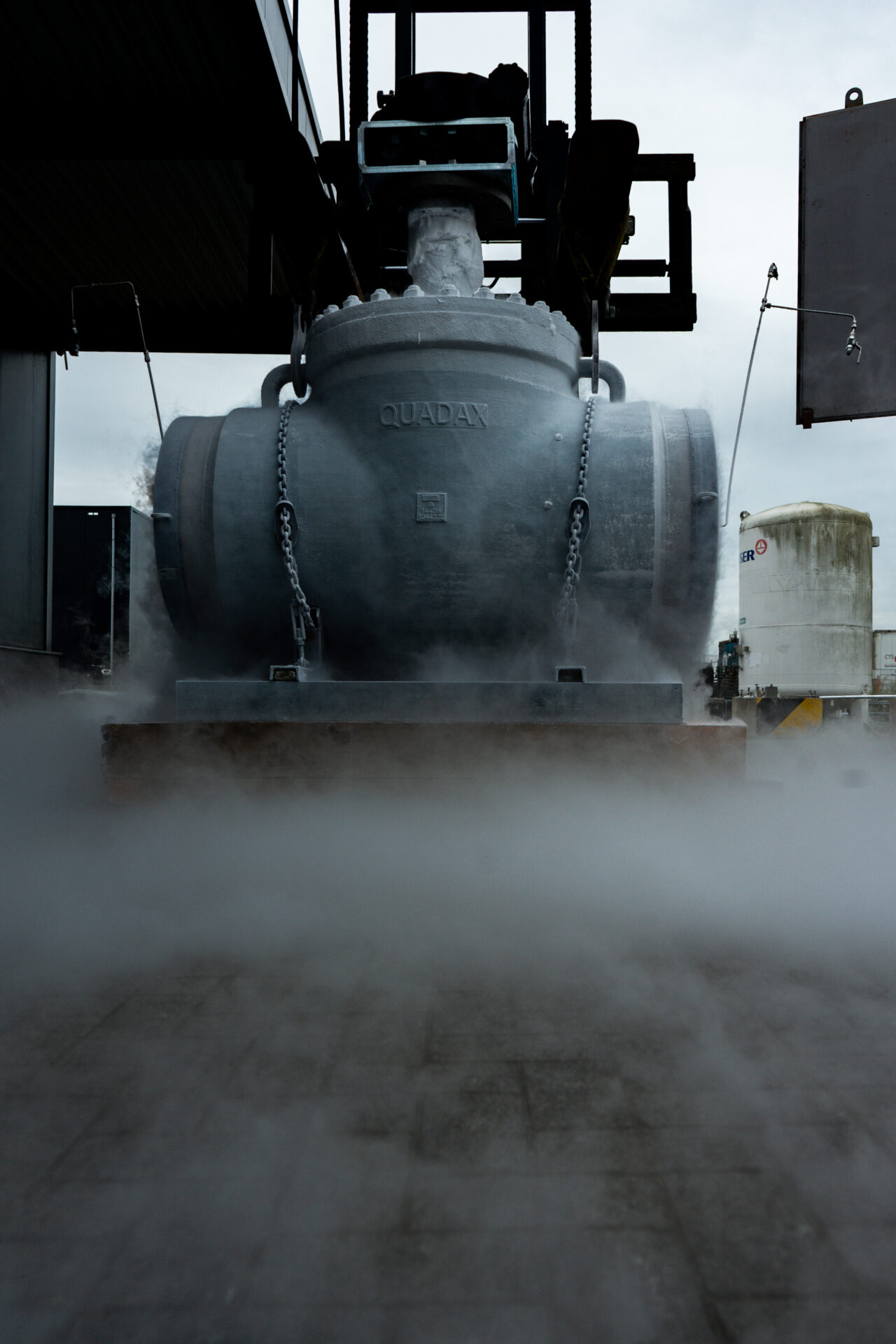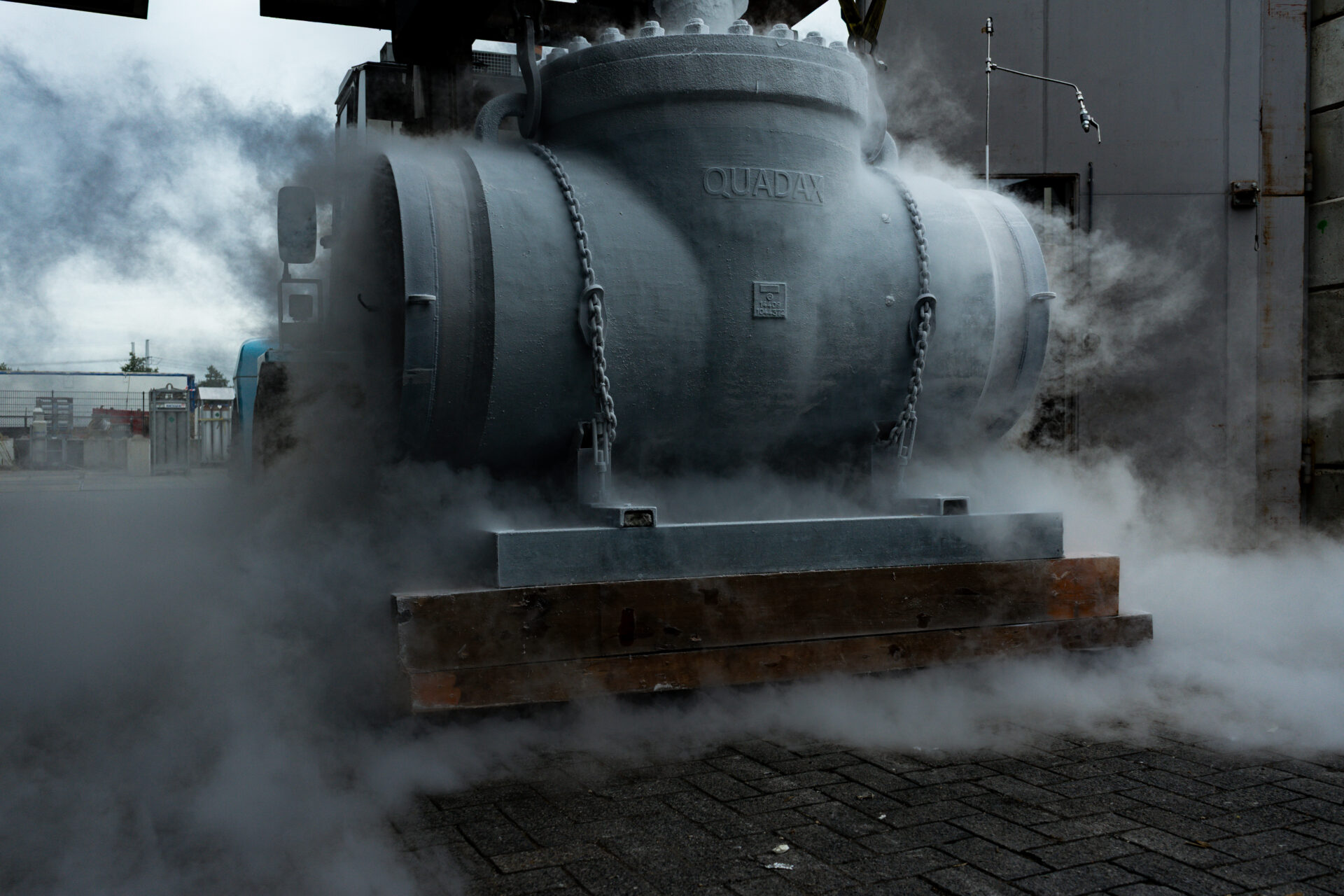

cryogene test

Extreme cold puts materials and components to the ultimate test. At temperatures down to −196 °C, valves, gaskets and joints can fail unexpectedly, leading to leaks, production stops or risks to people and the environment. Especially in sectors such as LNG, oil & gas, (petro)chemicals and industrial refrigeration, reliability at low temperature is not a luxury but a hard requirement.

An independent cryogenic test by ITIS tells you exactly whether your components will perform under these extreme conditions. We test to international standards, fully traceable and, where applicable, under ISO 17025 accreditation. This provides clear insight into performance, demonstrable compliance with requirements and prevents unpleasant surprises in service.

Need certainty at −196 °C? Have your components tested by ITIS, the specialist in cryogenic and low-temperature testing.

Have a cryogenic test carried out?

Do you have questions or would you like to have a cryogenic test performed? Contact us directly, we’re happy to help!
Ask IRIS

Do you have questions about a cryogenic test?

Do you have questions about a cryogenic test? There is no need to call anymore. With our digital specialist ‘IRIS’ you can get an immediate answer to any question you may have about this test. From general information to specific details, simply type in your question and receive a clear and relevant answer right away. For example, you can ask about:

  • Test options and specifications
  • Certifications and standards

Do you have questions about a cryogenic test? Ask IRIS directly.

What is a cryogenic test?

A cryogenic test assesses the functionality and tightness of pressure-retaining components and joints at low to extremely low temperatures down to the boiling point of liquid nitrogen (−196 °C). Most commonly this involves valves, for which cryogenic testing is often mandatory, but flange joints, gaskets, swivels and other assemblies can also be tested at cryogenic or low temperature.

Depending on the test type and component, we can measure, under cold conditions, the operating force or torque, internal and external leakage, and perform functional cycles. The cool-down is fully controlled and the test temperatures are monitored precisely.

What are the benefits of a cryogenic test?

  • Objective evidence of tightness and functionality down to −196 °C
  • Solid substantiation for design choices, material selection and sealing concepts
  • Less failure and unplanned downtime thanks to early detection of deviating behaviour
  • Demonstrable compliance with internal specifications, customer requirements and relevant standards
  • Clear acceptance criteria per test, translated into practical operating limits
  • Full transparency for stakeholders; results are traceable and auditable

Why is a cryogenic test necessary?

In installations operating at low or cryogenic temperatures, such as LNG, deep-cooled gas and refrigeration plants, the behaviour of components and materials can deviate from what is intended at operating or design temperature. In practice this means valves may not open or close (in time) or require excessive operating force, and internal or external leakage can occur under these conditions. The result in the field is increased safety risk, emissions, downtime and high costs. Cryogenic testing reduces these risks and provides objective, reproducible evidence that a design or production series is suitable for the intended low-temperature service.

What are the benefits of a cryogenic test?

A cryogenic test offers several advantages and prevents or mitigates various issues. Consider:

  • Objective evidence of tightness and functionality down to −196 °C
  • Solid substantiation for design choices, material selection and sealing concepts
  • Less failure and unplanned downtime thanks to early detection of deviating behaviour
  • Demonstrable compliance with internal specifications, customer requirements and relevant standards
  • Clear acceptance criteria per test, translated into practical operating limits
  • Full transparency for stakeholders; results are traceable and auditable

Who should perform a cryogenic test?

This applies mainly to asset owners with industrial installations, for the following reasons:

  • You gain greater certainty and insight into component performance through tests on, for example, tightness, operability and functional performance at low temperatures
  • You can make choices, depending on customer requirements, for test type (Type Approval or production test), test temperatures, acceptance criteria and measurands


Other reasons to test include: higher safety and reliability, lower risks, better business continuity, lower Total Cost of Ownership, and demonstrable compliance with laws and regulations
And also for manufacturers and suppliers, because:

  • It provides insight into product behaviour at operating and design temperature in accordance with international standards
  • You have independent testing to objectively verify functionality and tightness at low temperature, thereby reducing failure risk

Moreover, the tests offer more advantages, especially when carried out by ITIS. Think of benefits such as independent assessment, strictly controlled cool-down procedures, reproducible and traceable measurements, with clear reporting. You can also choose to watch live and online via a secure livestream in the ITIS Cloud Portal!

Why perform cryogenic testing at ITIS?

ITIS is the ideal partner for your company for the following reasons:

  • Proven expertise: hundreds of cryogenic tests performed in safe, fully equipped test bunkers
  • Precisely controlled cool-down processes and stable test conditions for reproducible results
  • Many test options, including: measurement of internal and external leakage; determination of operating forces and torques for valves; and endurance/cycle tests with automatic actuators, also for multi-turn valves
  • Testing according to ISO 28921-1 and ISO 28921-2, BS 6364 and Shell MESC SPE 77/200, plus custom protocols on request
  • Independent test laboratory; wherever possible tests are carried out under ISO 17025 accreditation
  • Optional live viewing via the ITIS Cloud Portal and fast, clear reporting

Report and certification of a cryogenic test

After completion you receive a comprehensive test report detailing test conditions, set-up, calibration chain, measurement uncertainty, raw data and a clear conclusion against the agreed criteria. Where applicable we carry out tests under ISO 17025 accreditation, increasing the international recognition and legal and contractual value of the results. Type approval results provide certainty on a design or product range; production tests demonstrate batch or series stability.

Accredited, certainty for you

ITIS is accredited by the Dutch Accreditation Council (RvA) under accreditation number L656. For you this means certainty. Our test and measurement results are demonstrably reliable and meet established quality standards.

Thanks to the international recognition via the ILAC MRA, results within scope are also accepted internationally. This avoids re-inspections, speeds up processes and builds confidence with customers, regulators and partners.

You work with an independent party that operates according to controlled procedures. This delivers clarity, consistency and a strong foundation for your decisions, both technical and commercial.

Gain certainty at extremely low temperatures

Reliable, demonstrable, and reproducible performance under extreme cold. With cryogenic testing, you can validate the functionality and leak tightness of pressure-retaining components and connections, such as valves, flanges, and gaskets, at temperatures down to -196 °C.

Frequently asked questions about a cryogenic test
What does cryogenic mean?

Conditions under which gases are liquid at very low temperatures, usually below −150 °C.

What is a cryogenic test?

A test that verifies whether a test object (e.g., valves or swivels) continues to function correctly at low temperatures and meets requirements for operability and internal/external leak tightness, both during cooling and afterwards, and often also after returning to room temperature.

Why are cryogenic tests necessary?

Low temperatures cause shrinkage, stresses, and brittle behavior, and reduce the elasticity of elastomers; without verification, this can lead to higher operating forces, seizing parts, and leaks.

What temperatures are used?

Depending on the standard and application. Often −196 °C (LN₂); other setpoints may apply for LNG, LOX, or LH₂.

Is testing also done at ambient temperature?

Yes. Usually a pre-test at ambient, then the cryophase and a short final test at room temperature.

What standards are common for cryogenic valve testing?

ISO 28921‑1 (production testing), ISO 28921‑2 (type approval), BS 6364 and Shell MESC SPE 77/200 and 77/306.

Custom procedures are possible if they are documented in advance.

Which standard should I choose?

Often the end user determines the standard. Deviating or additional requirements can be recorded in a project-specific test procedure, including setpoint, cooling rate, number of cycles, and leakage limits.

Are test results under ISO 17025 accreditation accepted worldwide?

Generally yes. ITIS is an ISO 17025 accredited testing laboratory and thus a conformity assessment body (CAB).

As an independent organization, we assess whether products, processes, persons, or services comply with legislation, standards, or specifications. Accreditation increases trust and international acceptance; the final acceptance lies with the customer/authority.

What information must be provided in advance?

Datasheet (DN/NPS, Class/PN, materials), drawing/BoM, sealing materials, standard/criteria, operation method (manual/gear/actuator), test medium, and any project specifications (purity, O₂ compatibility).

Does a test object need to be cleaned beforehand?

Yes. Test objects that need to be tested under cryogenic conditions must be completely free of: dirt, grease, oil, moisture. For (liquid) oxygen applications, additional cleaning and inspection requirements often apply.

Should SW ends (Socket Weld) of valves be welded first in order to test?

Not always. With screw or clamp adapters, testing can sometimes be done without welding. Whether this is safe mainly depends on the test pressure (and additionally on size/weight and temperature).

Note: adapters bring additional risks (dislodging, leaks). For higher pressures or heavier/cryogenic tests, we therefore recommend welded test flanges as the safest and most reliable solution. It remains a customized approach; contact us for the conditions per test.

What measuring equipment is needed?

Depending on the product, standard, and test objective.

Often: thermocouples at fixed measuring points with data logging, pressure sensors, helium mass spectrometer for external leakage, flow meters for seat leakage, and torque/force sensors for operation.

Standards can specify the number of measuring points, stabilization criteria, and accuracies; all instruments are calibrated and traceable.

Can cryogenic tests be performed under ISO 17025 accreditation?

Yes, provided the method falls within our scope. The current scope is available at the RvA; upon request, we will send the link or the certificate. Tests outside the scope are conducted according to the same procedures; the reporting is then not accredited.

How does the cooling process proceed?

Setpoint according to standard/customer requirement; controlled cooling with cold, evaporated nitrogen gas or LN₂; continuous temperature monitoring at measuring points to start as soon as all points have stabilized within tolerance.

How long does cooling and stabilizing take?

Until all prescribed measurement points reach the target temperature and fall within the stabilization criteria; duration depends, among other things, on the setpoint, standard, but especially the weight of the test object.

At what temperatures can testing be done?

Any setpoint below room temperature down to −196 °C (LN₂). Examples: −162 °C (LNG) and −183 °C (LOX).

Which medium is used for leak testing?

External: helium (pure or mixture) with mass spectrometer. Internal: usually dry nitrogen (N₂); around −196 °C we use helium as a medium because nitrogen can condense. Other media upon consultation.

How is seat leakage of a valve measured?

At a fixed pressure difference and flow direction, with a calibrated flow meter. Comparison with standard limit or pre-agreed limit.

Is the torque of a valve measured during a cryogenic test?

Yes, often prescribed. We measure torque or force under specified conditions and check against standard or customer limits.

How many operating cycles are required for valve testing?

Depending on the standard and configuration; usually multiple cycles.

What does Shell MESC SPE 77/200 entail?

Specification for low-temperature/cryoservice, including requirements for extended bonnet below −50 °C (vapour space), production and FE testing with leak limits, and reporting/marking.

What does BS 6364 entail?

British standard for cryogenic valves (−50 °C to −196 °C), including requirements for extended bonnet/gland, orientation requirements for the spindle, cycles and leak criteria for metal/soft seats, with reporting and marking.

What does ISO 28921-1 entail?

Pre-test at ambient, controlled cooling and stabilizing, low-pressure seat at low T, external leakage check with helium, functional cycles and torque measurement, then high-pressure seat in steps up to CWP and a short final test at ambient.

What does ISO 28921-2 entail?

Type approval between −50 °C and −196 °C with LN₂ or cooled gas; representative valve from the size range, fixed cycles and measurements on operating torque, seat and external leakage, plus full reporting.

What are typical acceptance criteria?

Thresholds for internal/external leakage and requirements for operability/operating moment; exact values are stated in the standard or project specification.

What happens if the valve in a cryogenic test does not fully open or close?

This is recorded as ‘non-compliant’ in the test report according to the applicable customer requirements and/or standard. The valve has thereby proven functional for the intended operating or design conditions. A retest is often only possible after corrective measures, for example a technical modification such as adjusting tolerances, followed by a full retest according to the same test procedure.

Should it be measured again after returning to room temperature?

Often yes, to determine lasting effects (e.g. cold deformation).

Which materials are suitable?

Austenitic stainless steels and nickel alloys generally perform well. Ferritic/duplex steel grades and certain cast qualities require extra attention; check impact toughness and minimum design temperature.

Seats: PTFE/filled PTFE low moments; PCTFE dimensionally stable to very low temperatures and suitable at higher pressures; PEEK limited.

Hard seats: graphite or metal. Elastomers lose elasticity at low temperatures and are often unsuitable as a primary seal.

What is a P-T (Pressure-Temperature) diagram for valves?

A P-T diagram is a chart or table that shows the maximum allowable pressure (P) a valve or the used material can have at a certain temperature (T). It is the basis for assessing whether a valve is suitable for your design and operating conditions.

Briefly explained

  • Purpose: determining the pressure rating at the operating temperature (derating at higher T, brittleness risk at low T).
  • Source: manufacturer data or standards (including ASME B16.34, EN 12516) per material (e.g. WCB, CF8M), pressure class (Class/PN) and connection.
  • Components: separate limits can apply for body/bonnet, bolts/flanges, seals and seats (PTFE, elastomer, graphite). The lowest limit determines the overall rating.
  • Media influence: some tables distinguish media(groups) and corrosion/impact allowances.

How do you use it?

  1. Select the material, pressure class and connection type of the valve.
  2. Locate the operating temperature on the T-axis and read the corresponding pressure.
  3. Check additional limits for seat/packing (soft seats often have lower T limits).
  4. Include safety margins and standard/customer requirements; the lowest of all subcomponents is decisive.
  5. If in doubt: always follow the manufacturer table for the specific type/serial number.

Important notes

  • Values are material- and standard-specific; do not use generic numbers.
  • High temperature ⇒ pressure rating decreases (derating).
  • Low temperature ⇒ watch toughness and impact requirements (brittle fracture).
  • Test pressure ≠ operating pressure: hydrotest/pneumatic tests follow separate rules and often temporarily exceed the operating rating under controlled conditions.
Why is a bonnet extension often prescribed for valves at low or cryogenic temperatures?

To keep the packing out of the cold zone. This reduces the risk of brittleness of a stem seal, ice formation, and higher operating torques, while allowing space for insulation and good operability. Length and design follow the applicable standard or customer requirement, such as ISO 28921, BS 6364, or Shell SPE 77/200.

Guideline: the extension must be long enough to keep the spindle packing at a temperature within the range of the packing material.

Is cryo-testing dangerous?

Yes. Main risks: O₂ displacement by evaporated LN₂, frostbite, brittleness of materials, and pressure build-up due to freezing.

We limit this with bunkers, ventilation and O₂ monitoring, shielding/interlocks, PPE, work instructions, and emergency procedures; only trained personnel conduct testing.

Can I follow the test live?

Yes, via the ITIS Cloud Portal (secure livestream). On-site witnessing by arrangement.

How long does a cryogenic test take?

That is difficult to predict without additional information. The duration largely depends on the mass and internal volume of the test object, test temperature and temperature profile, standard or procedure, the number of thermal cycles, and the test pressure(s). Heating up and controlled cooling usually take the most time.

What does a cryogenic test cost?

That depends on the same factors. For a targeted quote, we would like to receive: product type, weight and dimensions, setpoint(s), standard or procedure, number of cycles, test pressure(s) and the internal volume.

How do we combine hydrotesting with cryotesting?

Preferred order where allowed: first cryo, then hydro. If hydro is required beforehand, then strictly follow: draining and operating, long-term vacuum drying (possibly with dry N₂ purge), visual cleaning/inspection, where practical reassemble seals dry, verify dew point and only then cryo. Hydrostatic pressure can force water into capillaries; complete removal is difficult.

Is it difficult to pass a cryotest?

Yes. Due to shrinkage, increased friction, and material behavior, design faults and contaminants become apparent quickly; rejection rates are therefore relatively high.

Why is the rejection rate often high, and how do we reduce it?

Causes: residual water/oil/grease, non-qualified components (soft seats, gaskets, stem seals, bearings), unsuitable “low-temp” lubricants, tolerance/alignment issues, and insufficient conditioning.

Approach: test clean, dry, oil-free; dry/purge to low dew point; choose demonstrably cryo-suitable materials and lubricants with datasheet; ensure gentle cooling strategy and sufficient soaking time; component or mock-up prequalification.

What is the difference between a type test and a production test for low- or cryogenic temperature valves?

Type test: a design qualification at low or cryogenic temperature of one representative sample from a design family; the approval applies to sizes and pressure classes within that family, examples: ISO 28921-2, BS6364.

Production test: a sample of a valve from a batch to check whether the delivered production meets the specified requirements, examples: ISO 28921-1, Shell 77/200.

When do I choose a type test and when a production test?

A type test is often prescribed for a new or modified design, new size or pressure class, new materials, or changed sealing materials. Purpose: to qualify the design for the entire design family.

Choose a production test for series or project deliveries to verify batch conformity (sample or 100%, depending on standard/customer requirement) and for pre-shipment inspections.

At ITIS, it’s simply a given that we offer our customers the best service possible. We understand their needs and desires and are always focused on providing the highest quality service and solutions.

Logo
Logo
Logo
Logo
Logo
Logo
Logo
Logo
Logo
Jeroen De Dobbelaere
Hilde Nieuwdorp
Patrick Van Tol
We are rated on average with: To all reviews
8,9